Posts

BBC2 series: Exploring the Past: Protest with me talking about Peterloo

I'm down in the vaults of the National Archives for this BBC2 schools' series: http://www.bbc.co.uk/iplayer/episode/b04q12bj/exploring-the-past-protest The first ten minutes is on the Peterloo Massacre. Matthew, a bright and politically passionate school student from Radcliffe, investigates the causes of the massacre. I'm showing him extracts from the Home Office disturbance papers. It's available to watch on iplayer for the next three weeks.

what is public space? the freedom to protest

Image
This week controversy has re-arisen over the purpose and design of the proposed 'Garden Bridge' over the Thames in London. According to Oliver Wainwright's report in the Guardian, “All groups of eight or more visitors would be required to contact the Garden Bridge Trust to request a formal visit to the bridge,” states Lambeth council’s planning report to its committee, which recommends conditional planning. “This policy would not only assist visitor management but also would discourage protest groups from trying to access the bridge.”  Whether or not this gets enacted in practice is one matter, but the bigger issue is that planners think this way about what on the surface was marketed as a 'public' space open to all. And that their main reasons for limiting numbers was less 'assisting visitor management' and more about 'discouraging protest groups'. How many people form a 'tumultuous' crowd? The restriction on groups of...

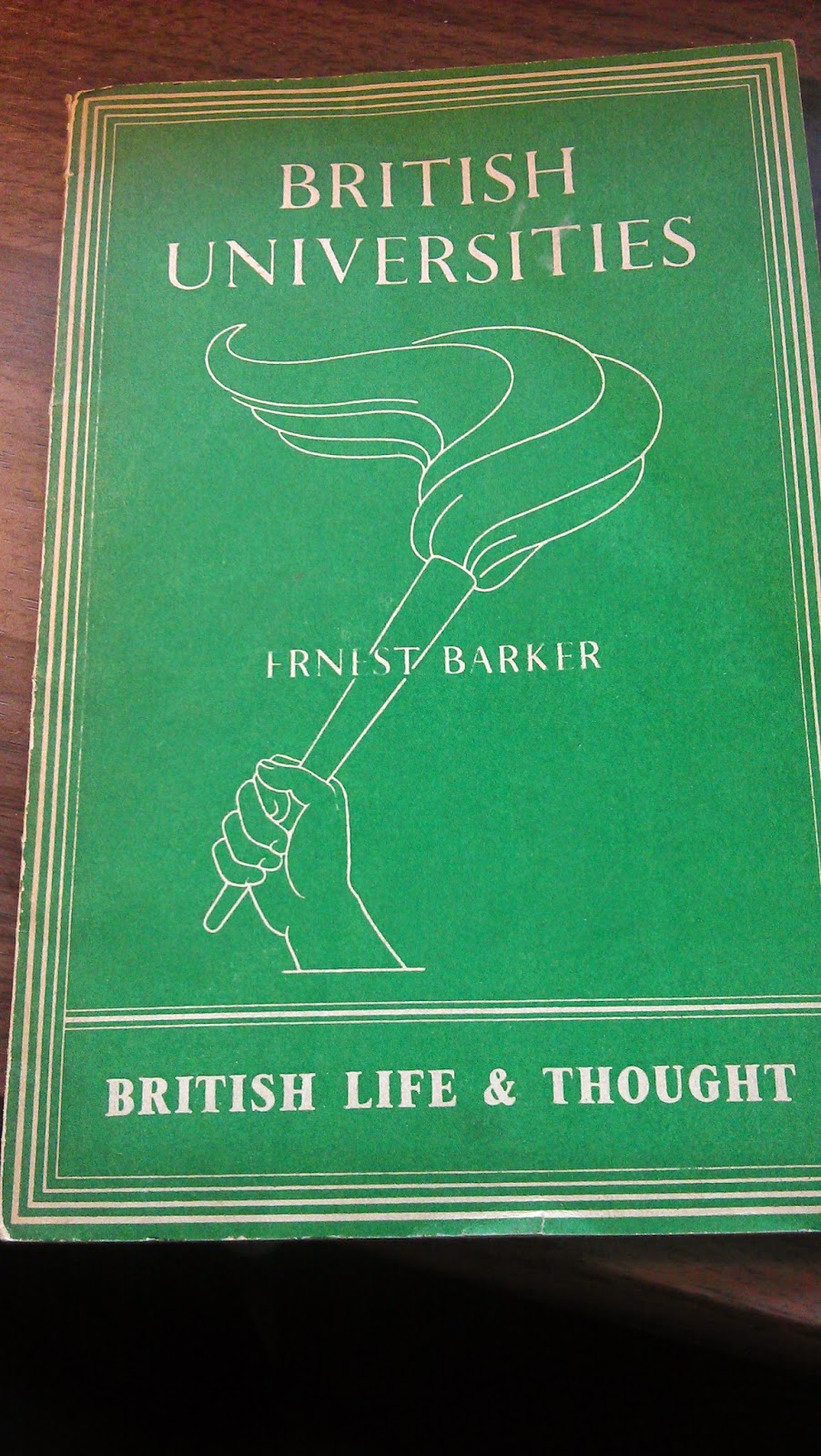
British Universities by Ernest Barker (1946)

Image
I bought this pamphlet in an idiosyncratic secondhand bookshop in Caterham yesterday. It's called British Universities , by Sir Ernest Barker, published by the British Council in 1946. It's a fascinating insight into thoughts about what universities were for, and should be, just after the War, and also how they were promoted to the rest of the Commonwealth. The list of other titles available in the series is also intriguing, and I would love to find more of these pamphlets, especially to compare their language and ideas with the current guide to British life given to people taking the citizenship test: Baker was Professor of political science at Cambridge, and the pamphlet describes him as 'the son of a working-class home in Northern England,' who 'combines a knowledge of University life with an understanding of the common people, who in our modern democracy, as in the Middle Ages, send many of their best sons to the Universities'. The pamphlet ...

I've finished the difficult second album!

Image
I haven't posted on this blog since the Tour de Yorkshire earlier in the summer because I was busy finishing my second book. And now it's done, and I sent it off to Manchester University Press yesterday. It's been an interesting and difficult process writing the second book. Whereas an academic historian's first book is generally 'the book of the PhD thesis', the second book is a different beast. my second book! 521 pages... In many ways it's very liberating: you don't need to rewrite a dense piece written for two examiners, but rather just start from the point you want to end at: a more expansive book that you hope people will want to read. But on the other hand, there are more difficulties than doing the PhD ms: there's no supervisor to give you deadlines or regular advice. You therefore: have to rely on colleagues and acquaintances to read drafts. They're obviously not paid to give you advice, so it's a huge ask of their...

Blackstone Edge, the Tour de Yorkshire, and Chartist meetings

Image
In 2009, I published an article about radical and Chartist meetings on moors. It's in Northern History , and you can read the pre-print here: https://www.academia.edu/535605/Moors_Fields_and_Popular_Protest_in_South_Lancashire_and_the_West_Riding_of_Yorkshire_1800-1848 The Chartists in particular were keen on holding mass meetings on moorland. In part this was because the radical movements were increasingly restricted in when and where they could hold large public meetings in the towns. But meeting on moors was also part of working-class culture, drawing from the Methodist camp meetings held on the same sites, a love of rambling, fell-racing and naturalism, and what Malcolm Chase terms 'radical agrarianism', an attachment to the land as representing freedom and self-sufficiency. Blackstone Edge Blackstone Edge was one of the most famous sites of Chartist monster meetings. Large processions from either side of the Pennines would trek up to sit in the declivity of th...

Euston station, 1842

Image
Illustrated London News, August 1842 Is this picture from the Illustrated London News from August 1842 showing: a) people attacking troops by Euston arch as they were on their way to board a train up North to suppress the general strike? or, b) the usual mad rush down the ramp on platform 14 to catch the 17.40 Virgin Pendolino to Manchester on a Friday evening?

Quick guide to digital history - digitisation, searching, xml, data-mining, big data, OCR, and more

I've finished teaching Tim Hitchcock's 3rd year undergraduate module on digital history. I did a crib sheet of the main areas for the postgraduate research seminar. Some of it is a bit idiosyncratic (and probably wrong) and requires me to explain it, but here it is: Read the worksheet and notes for the slides here: https://docs.google.com/document/d/1BVWpKpDkvY6LC16Ee39sisVHY82yq2HxZa7dgrFC4i8/pub